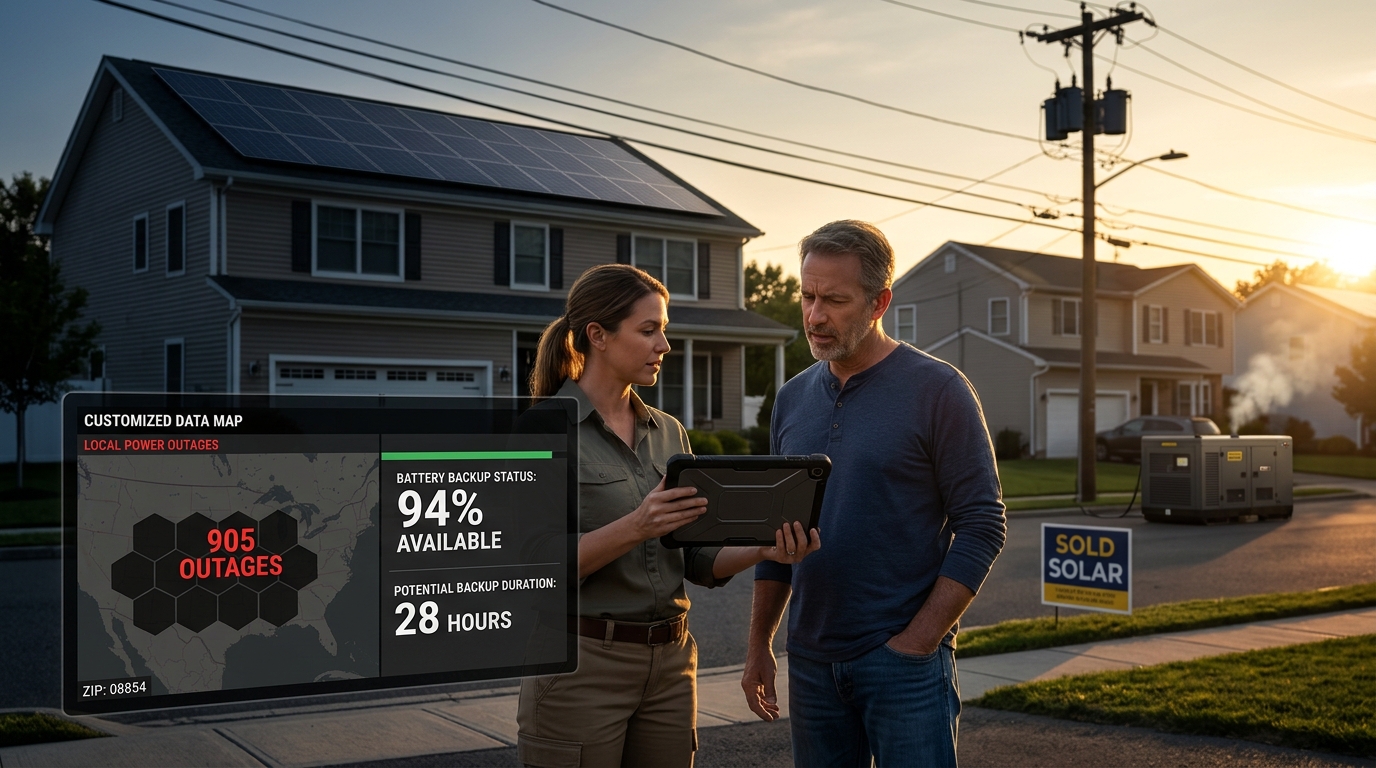
A homeowner who lost power for 10 hours last Tuesday doesn't need you to explain why grid reliability matters. They already know. The pitch after an outage is different from a cold knock: shorter, more concrete, and built around a problem they just lived through.
This playbook is for solar, battery, and generator reps working recently-hit streets. Before the pitch comes the knock. We ranked the best door-to-door openers separately. The fresh-outage line wins.
How do I pitch solar after a power outage?
Lead with what happened to them, not what you sell. Pull up the outage data for their ZIP before you knock. If their neighborhood had a 6-hour outage on Tuesday caused by equipment failure, say that. "I saw your area lost power for six hours last week. That's the third time this quarter" is a conversation starter. "Would you like to learn about solar energy?" is a door closing in your face.
The pitch has three parts:
- Name the problem with their data. "Your county had 4,799 outage events last month. Your ZIP had power out three times in 30 days." Specific numbers from your territory's grid profile beat vague claims about an aging grid. Our state-by-state grid breakdown shows which states break most often and why.
- Show the solution is permanent. Solar panels alone don't keep the lights on during an outage. You need a battery. Make sure the homeowner knows you're talking about solar plus storage, not just panels on the roof.
- Make the math local. At 36.2 cents per kWh in California or 27.6 cents in New Jersey, the payback period is shorter than most homeowners expect. Pull the rate for their utility, not a national average.
The timing matters. Knock within 7 days of an outage event. After two weeks, the frustration fades and they're back to thinking "it probably won't happen again."
What do homeowners care about after a power outage?
They care about three things, and none of them is their carbon footprint. Keeping the lights and fridge running is first. A family that threw out $400 in groceries after a 12-hour outage remembers that number. Not being helpless next time is second: the feeling of sitting in the dark waiting for a utility truck is what drives action. Cost is third, but only after the first two land.
States with the longest restoration times produce the most motivated buyers. New York averages 27 hours to restore power. Nebraska averages 10.6 hours. Oregon averages 7.6 hours. We broke down restoration times by state in our territory planning guide. The longer the outage lasted, the more time the homeowner had to think about alternatives.
Counties where outages happen almost daily are even stronger. Pierce County, Washington had outages on 24 of the last 30 days. That's not a one-time event. It's a pattern. Homeowners in chronic-outage counties don't need convincing that the grid is unreliable. They need someone to show up with a solution.
Don't lead with environmental benefits or energy independence as abstract concepts. Lead with "your power went out, here's how to make sure it doesn't happen again, and here's what it costs."
Is solar + battery a good pitch for grid reliability?
Yes. It's the only residential option that both eliminates the electric bill and keeps the house running during an outage. A generator does one of those things. Solar without a battery does the other. Solar plus storage does both.
The pitch works best in counties where outages are frequent but not catastrophic. A neighborhood that loses power for 4-8 hours every few weeks is a better battery market than one that had a single 48-hour outage from a hurricane. Frequent outages create ongoing frustration. One-off disasters create insurance claims.
Back it with numbers from the homeowner's own area. If their county had equipment failure as the top cause, which is the leading identified cause nationally, that means aging infrastructure, not a freak storm. Equipment doesn't get younger. The outages will keep coming.
Battery sizing matters at the door. Most homeowners don't realize a standard solar battery can keep their fridge, lights, Wi-Fi, and a few outlets running for 8-12 hours. That covers the vast majority of outages. You're not selling a whole-home generator replacement. You're selling "your kitchen stays on while the neighbors sit in the dark."
How do I compete with generator companies for outage leads?
Generators win on upfront cost and simplicity. A whole-home standby generator runs $5,000-$15,000 installed. Solar plus battery starts around $25,000-$40,000 before incentives. If the homeowner is only thinking about backup power, the generator looks like an obvious choice.
You win on total cost of ownership and the monthly bill. A generator sits in the yard burning natural gas or propane every time it runs. Solar plus battery eliminates or reduces the electric bill every month, outage or not. Over 10 years, the generator costs more. The homeowner still pays their full electric bill on top of it.
Three angles that work against generators:
- "What happens between outages?" A generator does nothing 99% of the time. Solar panels reduce or eliminate the electric bill every day. At 36.2 cents/kWh in California, that's real money every month.
- "Generators need maintenance." Oil changes, fuel storage, annual servicing. A battery has no moving parts. Solar panels last 25 years with essentially zero maintenance.
- "Incentives close the gap." The federal tax credit covers 30% of solar plus battery. Most states have additional rebates. After incentives, the price gap between a generator and solar-plus-storage shrinks fast. A generator has no federal tax credit.
Don't trash generators. Some homeowners want both: a generator for extended outages and solar for daily savings. But if they're choosing one, make the 10-year math clear.
What data should I bring to a solar pitch?
Bring three things, all specific to the homeowner's ZIP code. Generic state-level stats don't land at the door.
- Recent outage events in their ZIP. Not the county average: the actual events in their neighborhood from the last 7-30 days. "Your ZIP had power out on March 3rd, March 11th, and March 22nd" is specific enough to get a reaction. You can pull this from a free grid profile.
- Their electricity rate. Look up the residential rate for their utility on the EIA website, or pull it from a GridProfile report. The difference between quoting "the national average" and quoting "your rate of 27.6 cents per kilowatt-hour" is the difference between a brochure and a conversation.
- Outage cause and duration. If their area's outages are caused by aging equipment or vegetation contact, that's a recurring problem, not a one-time event. If their average restoration time is 6+ hours, say so. "Your area averages 7 hours without power per outage" gives the homeowner a reason to act now.
Skip the 30-page proposal at the door. You're not closing on the first visit. You're getting a sit-down appointment. The data gets you in the door. The full proposal happens at the kitchen table.
Counties with a mix of cause types (equipment failure, animal contact, vehicle strikes) are places where the grid fails in multiple ways. That's a stronger pitch than a county where all outages come from one seasonal cause. One cause might get fixed. Five causes mean the infrastructure needs replacing.
The outage pitch is one channel among several. Our guide to getting solar leads compares it to bought leads, referrals, and ads, with the cost math for each. If you want the ZIP-level breakdown for your territory, grab a free grid profile: pick your state and counties and we'll send you the outage events, causes, restoration times, and demographics for every ZIP.