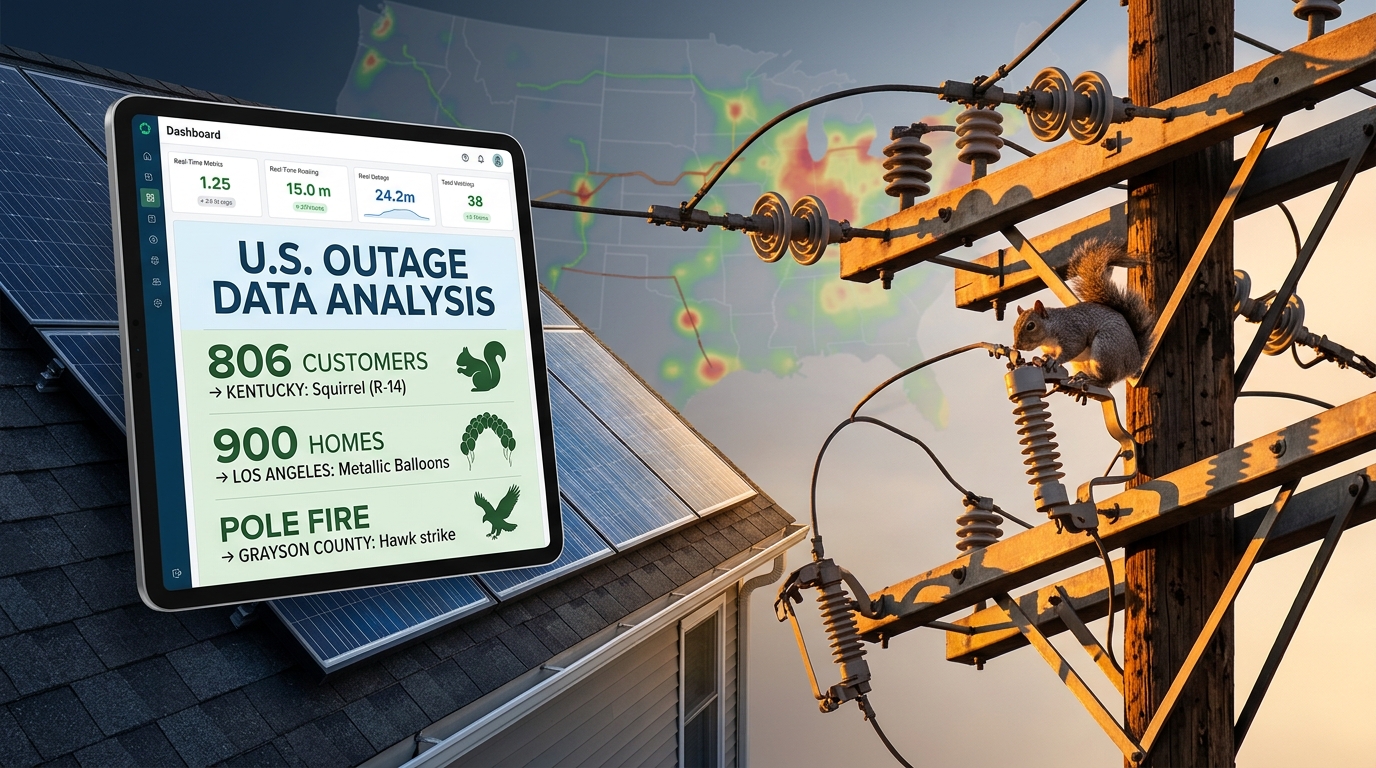
A squirrel in Kentucky knocked out 806 customers in a single event. A hawk in Grayson County caught the top of a utility pole on fire. In Los Angeles, four metallic balloons drifted into power lines in a single weekend, cutting power to over 900 homes combined.
These aren't hypotheticals. They're real cause descriptions from utility outage reports filed in the last year. And they show up in the data more often than you'd expect. If you run a solar, battery, or generator sales team, the weird causes are more than trivia: they mark the grids that fail for any reason at all.
How often do animals cause power outages?
747 animal-caused outage events hit the grid in the last 12 months, affecting over 24,000 customers. Squirrels are the headliner, but the full cast includes birds, raccoons, snakes, and whatever "wildlife" covers when a utility doesn't want to be more specific.
Multnomah County, Oregon leads the country with 52 animal-caused events. Converse County, Wyoming logged 42. Salt Lake County, Utah had 26, affecting 854 customers.
The average animal outage lasts about 3-4 hours to fix. But outliers exist. One squirrel event in the data shows an average duration of 354 hours across 6 incidents in a single county, which likely reflects cascading equipment damage rather than a single chewed wire.
Can a balloon cause a power outage?
Yes, and it happens regularly. Los Angeles County had four balloon-caused outages in one weekend in March 2026, each knocking out 230-265 customers. The cause shows up in utility reports as "Metallic Balloons in Equipment."
Balloons are part of a broader category: foreign objects in equipment. In the first two weeks of April alone, Butte County, California lost power for 3,034 customers from a foreign object. San Bernardino County had a 2,064-customer event from the same cause. These aren't minor blips.
"Foreign Object Blown By Wind" is its own category. Three events logged under that label averaged 52 customers each, with one hitting 153.
How many outages are caused by vehicle accidents?
620 vehicle-related outages in the last year, affecting over 42,000 customers. Average restoration time: 7 hours. A car into a pole doesn't just take out a transformer. It often snaps the pole itself, which means a full replacement before power comes back.
The biggest single vehicle event: 3,816 customers out in Linn County, Oregon, lasting 10.7 hours. Snohomish County, Washington had one that knocked out 2,899 customers for nearly 12 hours. These are small-city-scale outages caused by one driver and one pole.
Traffic accidents that hit utility infrastructure average 15.8 hours to restore, more than double the overall vehicle average. When a utility pole goes down on a busy road, traffic control and road crews have to coordinate with line crews before anyone can start pulling wire.
Do utility poles catch fire?
More than you'd think. 34 pole fire events in the last year, mostly in California and the western states. Average restoration: 7-9 hours.
PG&E reported pole fires in Solano, Kern, Merced, Fresno, and Kings counties in a single week in late March. The Solano County event lasted 13.2 hours and hit 360 customers. Kern County had two events on the same day.
The Grayson County, Kentucky event is the best single-line cause description in the entire dataset: "Crew on site, hawk caught top of pole on fire. Able to downgrade." A hawk landed on a pole, shorted the equipment, and set the pole on fire. 36 customers lost power.
Pole fires turn out to be a bigger pattern than a one-off hawk. We dug into where pole fires cluster and why they cause such long outages: 137 of them in 75 days, averaging over 12 hours to restore.
What happens when someone digs into a power line?
Construction crews hitting underground cables is common enough to have its own cause code. "Dig Into Underground Service" appears 8 times in recent data, with one event in San Bernardino County taking out 830 customers.
The irony: every state has a 811 "call before you dig" law. The outages still happen.
What do unusual outage causes tell you about a territory?
The causes above account for a small share of total outage volume. Equipment failure and vegetation are still the big two, as we covered in our breakdown of what actually causes US power outages. But the weird causes are useful signals for a different reason.
A county where animals, balloons, and vehicles regularly cause outages is a county where the grid runs close to the edge. One squirrel shouldn't take out 800 homes. When it does, that's aging equipment with no redundancy. The same homeowners who lost power to a balloon are the ones most likely to say yes to a solar and battery pitch.
If you're prospecting in counties with high event counts from our state-by-state breakdown, check what's causing the outages. A county with a mix of animal, vehicle, and equipment failures has infrastructure that fails in multiple ways. That's a territory where "what happens when the grid goes down" isn't a hypothetical. It happened last week, and it might have been a squirrel.
Grab a free grid profile to see which ZIPs in your territory had outages this week, what caused them, and how long they lasted.