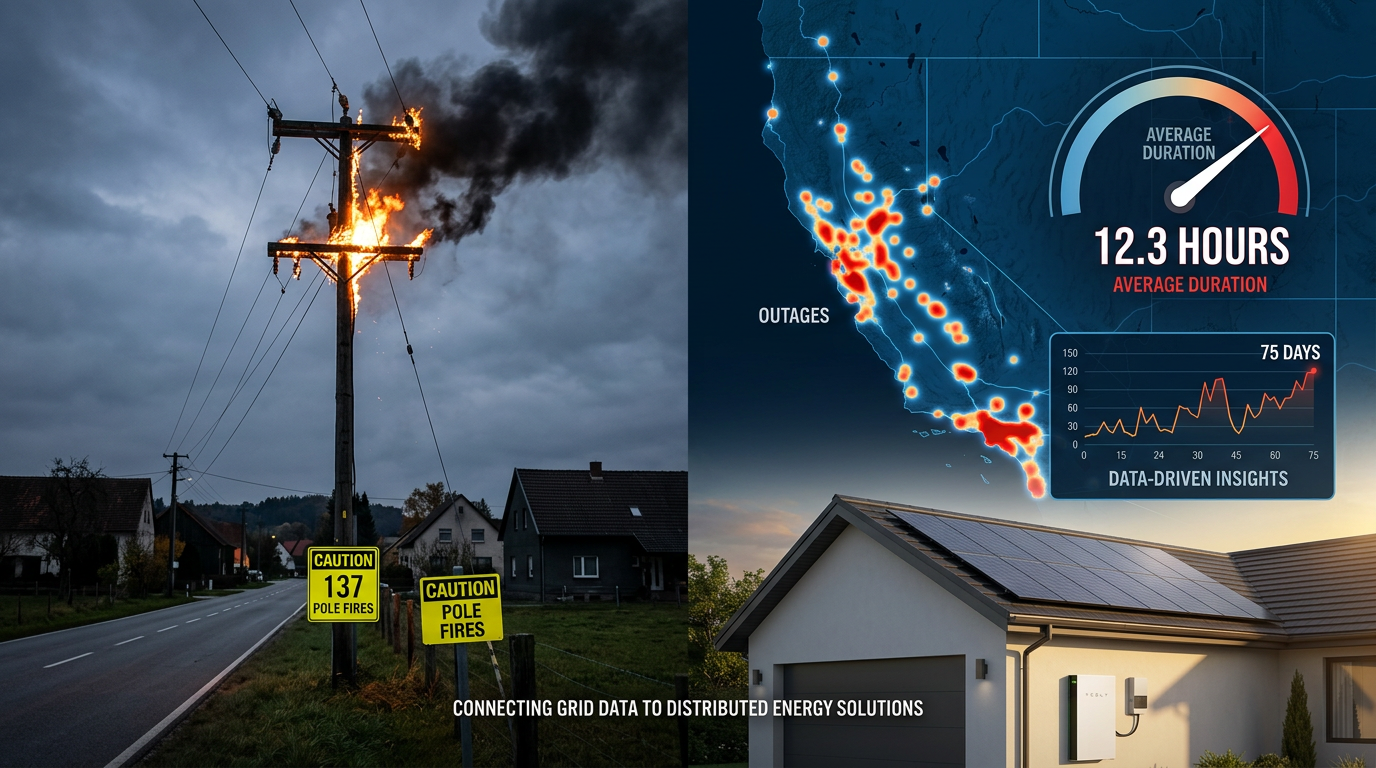
137 power poles caught fire and took out the grid in the last 75 days. Each one kept the lights off for an average of 12.3 hours, about four times longer than a typical outage. Together they cut power to more than 22,000 customers, mostly in rural counties where the next pole is a long drive away. If you run a generator or battery sales team, those counties are worth knowing by name. A 12-hour outage is exactly the event that sells backup power.
A pole fire is exactly what it sounds like: the wooden utility pole itself burns. It's a specific, labeled cause in utility outage data, separate from wildfires and storms, and it clusters in two very different parts of the country.
What causes long power outages in Utah and the Mountain West?
Pole fires are a leading cause of 12-hour-plus outages across the Mountain West. Rocky Mountain Power reported a pole fire in Utah County, Utah that cut 3,411 customers on April 26, 2026. Nine days later, another Utah County pole fire kept 1,445 customers out for 29.4 hours.
The same utility family (Rocky Mountain Power, PacifiCorp, and Pacific Power) logged pole fires across Wyoming, Idaho, Oregon, and Washington in the same window. Sweetwater County, Wyoming lost 1,071 customers to a pole fire that took 33.5 hours to restore. Avista reported a pole fire in Nez Perce County, Idaho that hit 1,062 customers.
These aren't dense metros. They're counties with long distribution lines, few crews, and no quick fix when a pole burns down.
Where are pole fires knocking out power?
Pole fires split into two clusters. The Mountain West is one: Utah, Wyoming, Idaho, Washington, and Oregon, served by the PacifiCorp utilities and Avista.
The other is California's Central Valley, where PG&E carries most of the load:
- Fresno County: 1,968 customers out on April 13 (10.9 hours), then 1,256 more on May 12.
- Solano County: 1,872 customers on April 1 (13.2 hours), with a second pole fire on May 13.
- San Joaquin County: 1,582 customers on April 25, out for 20.6 hours.
- Kern County: 339 customers on April 1.
This is a different grid than the wildfire-driven outages further south. We broke down the full county-level California outage picture separately. Pole fires are one slice of it, concentrated inland where PG&E's older distribution hardware meets dry, dusty heat.
How long do pole-fire outages last?
Pole-fire outages averaged 12.3 hours to restore over the last 75 days. A normal outage in the same data runs about 3 hours, so a pole fire keeps a home dark roughly four times as long.
The worst ran far longer:
- Sweetwater County, Wyoming: 33.5 hours.
- Utah County, Utah: 29.4 hours.
- Yakima County, Washington: 23.3 hours (Pacific Power).
- San Joaquin County, California: 20.6 hours.
The reason is physical. You can't reset a breaker on a burned pole. A crew has to find it, kill the line, replace the pole, restring the wire, and re-energize, often on a rural road, sometimes overnight.
Why do utility poles catch fire?
A pole fire starts at the top, not the bottom. Leaking insulators, contamination on the hardware, and aging connectors let current arc across the surface of the pole. Add dust, salt, or pollen and a dry spell, and the wood ignites where the current is tracking.
That's why pole fires concentrate where they do. The Central Valley and the high desert both run hot and dry, with airborne dust and old distribution lines. The hardware was built for a wetter, cooler grid than the one it's sitting on now.
Are pole-fire counties good territory for backup power sales?
Counties with repeat pole fires are strong backup-power territory. Utah County and Fresno County each had two separate pole fires in this window: the same neighborhoods losing power for 10 to 30 hours, more than once a season.
A 12-hour outage is past the point a battery alone covers a house, which makes these counties a whole-home generator pitch more than a battery one. A homeowner who sat through a 29-hour outage in May isn't debating whether to buy. They're picking a dealer.
Pole fires also sit alongside the other unusual outage causes (squirrels, balloons, cars into poles) that share one trait: when a single point of failure takes out hundreds of homes for half a day, that's a grid running with no redundancy. That's the signal backup-power dealers sell against, and it's the structural-decay end of the answer to whether outages are getting worse.
To see which ZIPs in these counties had recent outages, and which causes show up most, grab a free grid profile. Pick your state and up to three counties and we'll email you the breakdown.