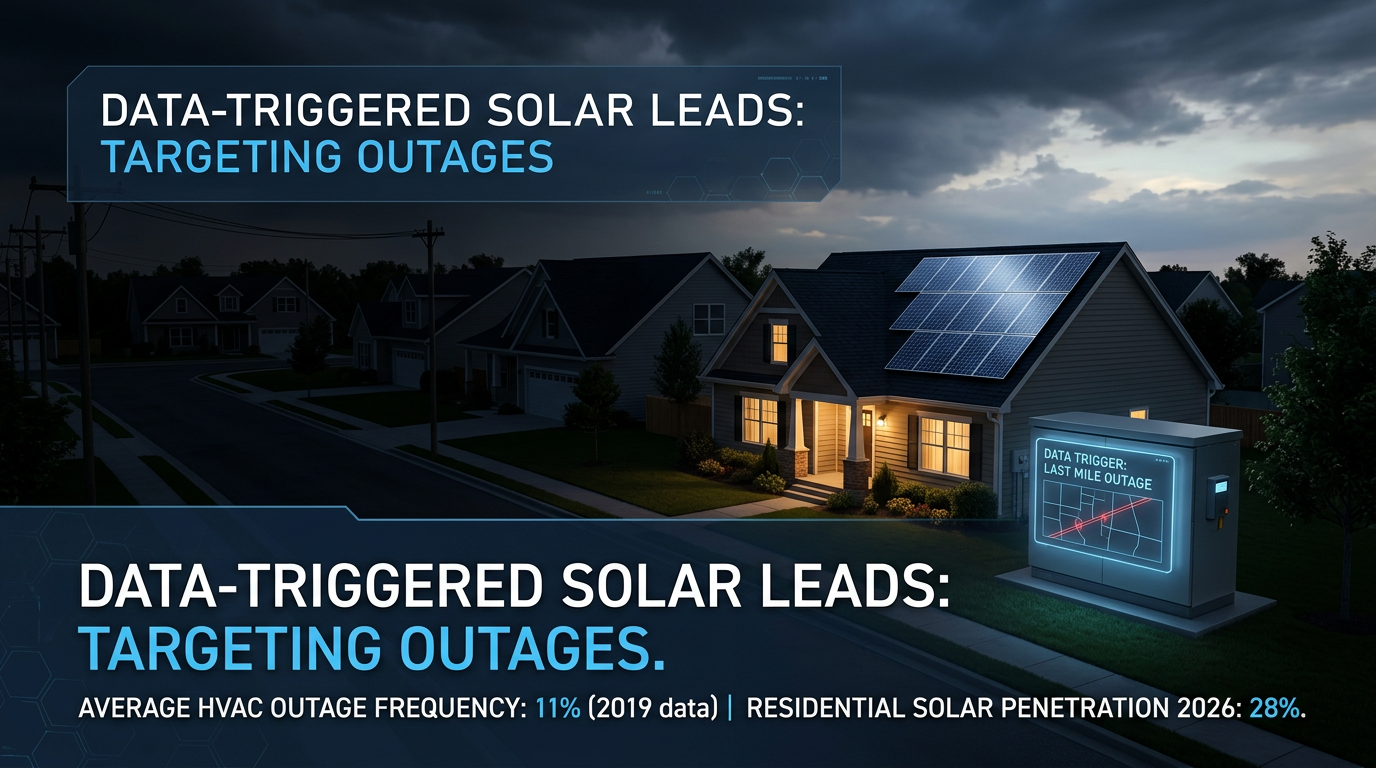
Most guides to solar lead generation list the same ten channels and tell you to "test what works." The more useful question is one layer up: every solar lead on the market belongs to one of three categories, and the category decides how much you pay, how many competitors are calling the same homeowner, and how warm the door is when you get there.
The three categories are leads someone else generated (shared, exclusive, and aged form-fills), leads you generate yourself (referrals, ads, content, canvassing), and leads identified by a demand event: homes flagged by something that just happened to them, like a power outage, before anyone filled out a form. Most installers know the first two. Almost nobody is working the third, which is exactly why it's worth understanding.
This is the hub for our lead-generation coverage. The channel-by-channel breakdown is below, with links to the deeper playbooks on territory selection, door openers, and pitching after an outage.
Where can I get solar leads?
Solar leads come from three places: vendors who sell you homeowners that filled out a form, marketing you run yourself, and data that tells you which homes to approach before any form exists. Here's the full channel map.
Lead vendors. Companies like SolarReviews, RGR Marketing, and Solar Exclusive run consumer-facing quote forms and sell the submissions to installers. The product comes in three grades: shared leads sold to several installers at once, exclusive leads sold to one buyer, and aged leads, which are form-fills weeks or months old, sold in bulk at a steep discount. Fast to start, zero marketing skill required, and you're renting demand you'll never own.
Referrals. The highest-closing channel in the industry, because the trust is borrowed from a neighbor instead of built at a door. The catch is volume: referrals scale with your install base, so a new company can't live on them. Pay real money per closed referral ($500-$1,000 is common) and ask at the moment the system turns on, when the customer is happiest.
Digital marketing. Google Ads, Facebook and other social ads, SEO, and local-services listings. You own the pipeline and the lead is exclusive by definition, but solar is one of the most expensive ad categories in home services. Clicks on high-intent solar keywords routinely cost $10-$25, and it takes dozens of clicks to produce one signed contract. This channel rewards companies that can spend consistently for months, and punishes everyone else.
Door-to-door canvassing. Still the volume engine for most residential solar teams. The economics are driven almost entirely by one decision made before anyone knocks: which streets. A crew on the wrong streets burns wages; the same crew on streets picked with data produces appointments. More on that below.
Data-driven lists. Instead of waiting for a homeowner to fill out a form, you start from data (property records, roof characteristics, electricity rates, grid events) and build the list of homes worth approaching. Property-data platforms cover the static signals (single-family, owner-occupied, home value). The newest version of this channel is the outage-triggered list: homes that just lost power, identified by name and address. That's the third category, and it gets its own section below.
Should I buy solar leads or generate my own?
Buy leads when you need pipeline this month; generate your own when you want margin next year. The honest math on each side:
A shared lead is typically resold to somewhere between three and eight installers. The homeowner who filled out one form gets a week of competing phone calls, and the sale usually goes to whoever dialed first or quoted cheapest. You can win that game, but it's a speed-and-price game, and it resets to zero every month you stop paying.
An aged lead costs a dollar or two instead of fifty, and it performs like what it is: a person who wanted quotes in March being called in June. Aged lists can work for teams with cheap, persistent outbound capacity. For everyone else, the low price is the product.
Self-generated leads close at a multiple of purchased ones because there's no race: the homeowner is talking to you and only you. The cost is time. Ads take weeks of spend to tune. SEO takes months. Referrals take an install base. Canvassing is the exception: it produces self-generated, exclusive conversations in week one, which is why it remains the default growth channel for new solar companies despite being the least glamorous.
The practical answer for most teams is a blend, weighted by how well you know your numbers. Which brings up cost.
How much do solar leads cost?
Shared solar leads typically sell for $20-$100 each, exclusive leads for $75-$300, and aged leads for under $5. But the per-lead price is the least useful number in the business. The number that decides whether a channel works is cost per closed install.
Run it once and the channels rearrange themselves. A $40 shared lead that closes at 2% costs $2,000 per install before you've paid a setter or a rep. A $200 exclusive lead closing at 8% costs $2,500. A canvassing program paying $25/hour that produces one install per 60 hours of doors costs $1,500. Industry estimates put the all-in customer-acquisition cost for residential solar at several thousand dollars per install, and it's often the largest single line item after hardware.
Three questions to ask any lead vendor before buying: how many buyers see each lead, how old is the lead when you receive it, and what's the return policy on disconnected numbers and renters. The answers move the real price more than the sticker does.
How do door-to-door teams decide where to knock?
The best canvassing teams pick streets with data before anyone leaves the office, because territory choice moves results more than any script. Three numbers do most of the work: grid stress, housing type, and electricity rates.
Grid stress varies more than most reps assume. New Jersey logged about 965 outage events per county in the last 30 days, the highest density in the country. Harris County, Texas alone recorded just over 20,000 events in the same window. A homeowner in those areas has lived the reliability problem recently; a homeowner in a quiet-grid ZIP has to be talked into caring.
Housing type and rates decide whether the interest can convert. Single-family share above 60% (Census table B25024), owner-occupancy above 50%, and residential rates north of 25 cents/kWh (California sits around 36 cents) turn a knock into a viable project instead of a nice conversation. We walk through the full ranking method in how to pick a solar sales territory, with current state and county numbers.
Once the streets are picked, the door itself is a separate skill. We ranked the openers that survive the first five seconds (the winner names a real, recent outage and never mentions the product) and wrote a full playbook for pitching solar after a power outage, where the close rate is highest.
What are outage-triggered solar leads?
An outage-triggered lead is a home identified by a demand event instead of a form-fill: the house lost power last week, and you know it by name and address. It's a third category of lead, neither fresh opt-in nor aged, and it behaves differently from both.
Nobody on the list raised their hand, which sounds like a weakness and works like a moat. A form-fill is, by definition, already being sold or already talking to a competitor. A home that sat through a six-hour outage on Tuesday appears on no vendor's list. You're the first and usually the only company to bring it up, and what you bring up is their week, not your product.
The timing is the second edge. Backup power is an abstract pitch eleven months a year and an urgent one the week after the lights went out. Restoration data shows why the window matters in some markets more than others: over the last 90 days, Oregon averaged 7.3 hours to restore power across roughly 18,600 events, Nevada averaged 9.9 hours, and Michigan's slowest 10% of outages ran past 15.9 hours. Those aren't flickers. Those are evenings of dead refrigerators and dark houses, and the homeowners remember which evening.
The same trigger works across products. Frequent short outages favor a solar-plus-battery pitch; long restoration times favor generators. We mapped which territories lean which way, and broke out the lead mechanics for generator dealers and battery installers separately. And because the signal is an event rather than an opinion, it stacks with everything above: run the static filters (single-family, owner-occupied, rates) first, then let outages tell you when each qualifying street is warm.
This is the category GridProfile was built for. Our leads product resolves utility outage reports down to named homes and addresses, so a canvassing team can knock the exact street that lost power last week, and the opener at the door is verifiably true.
What is the best lead strategy for a new solar company?
Start with the channels that cost effort instead of cash: referrals from every install you complete, and canvassing on streets picked with data rather than vibes. Both produce exclusive conversations from week one, and both compound: your install base feeds referrals, and your door results teach you which territory signals matter in your market.
Add purchased leads once you know your close rate, and only then. Without a close rate, a lead vendor's pricing is unanswerable; with one, every channel reduces to cost per install and the decision makes itself. Treat aged leads as a capacity filler for slow weeks, never as a growth plan.
And whatever the mix, put a demand trigger under it. The cheapest improvement to any channel above is timing: calling, knocking, or mailing the homes where backup power stopped being hypothetical days ago. You can get a free grid profile of your territory to see the outage activity in your market, or go straight to the named homes below.