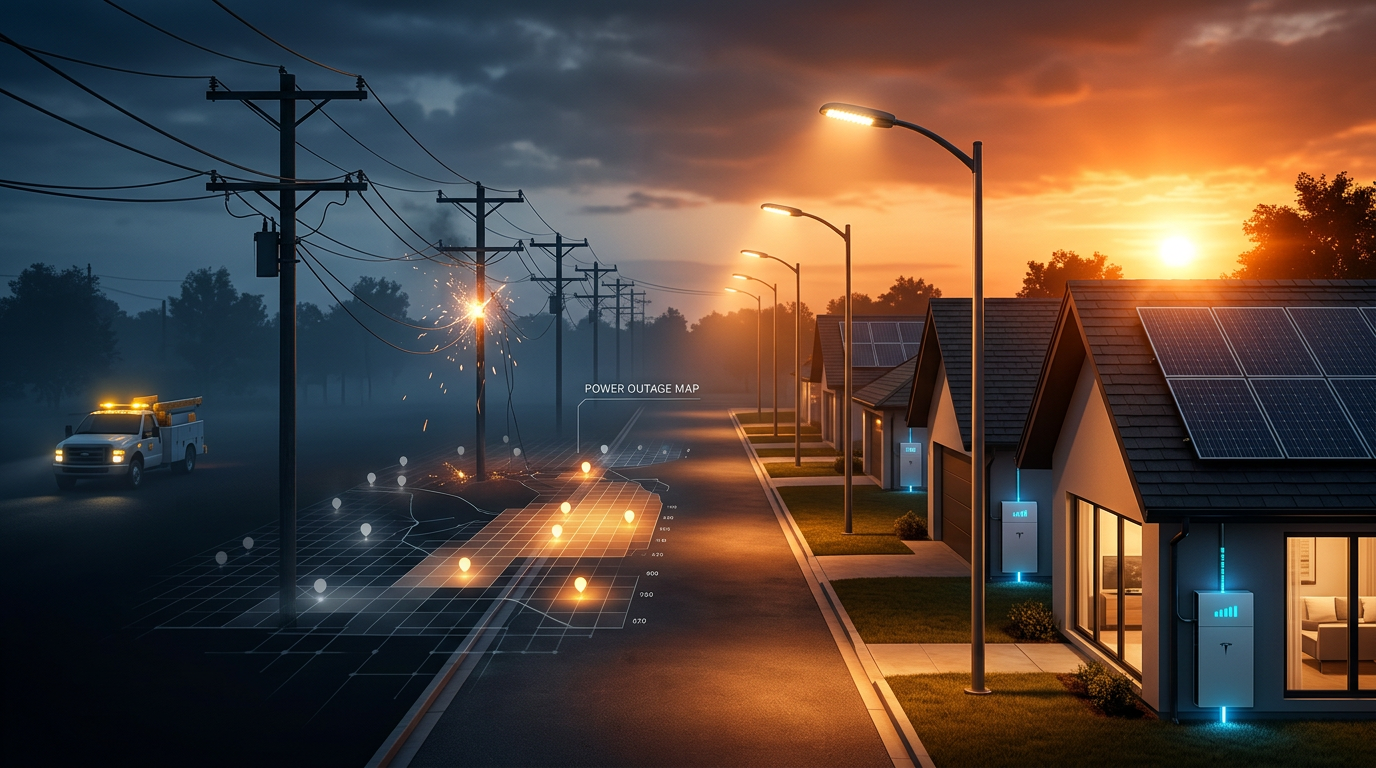
The strongest door-to-door opener in energy sales right now is a homeowner naming their own bad week back to them. "We heard Pacific Power had an outage around here last Friday afternoon. A tree took down a line. Did you folks get hit?" It's true, it's fresh, and it never says the word solar. That's why it works.
This guide is for solar, battery, and generator sales teams and the reps they put on doors. Most doors close in the first five seconds, and almost none of them close because of the words. They close because the homeowner pattern-matched you to "someone selling something" before you finished your sentence. A good opener breaks that match. A bad one confirms it. Here's how the common ones stack up, ranked by how reliably each one earns the next thirty seconds.
What is the best door-to-door sales opener?
The fresh-outage observation is the best opener, and it isn't close. You name a real event the homeowner lived through days ago, ask about their experience, and say nothing about what you install.
"Hi, I'm [Name] with [Company]. We heard Pacific Power had an outage around here last Friday, a tree took down a line. Did you folks get hit?"
It works on three levers at once. The specificity (a named utility, a day, a cause) reads as a neighbor who noticed, not a rep with a clipboard. The question is about them, not your product. And the pain is recent, so you're not creating a problem in their head. You're touching one that's already there. For a backup-power rep, a fresh outage is what a hailstorm is to a roofer: the event that tells you which doors are worth knocking, and the reason the homeowner is willing to talk.
The one requirement is that it has to be true for that house. Which is the whole catch, and we'll come back to it.
The opener tier list
S-tier: the fresh-outage observation
Covered above. The only opener that combines a real trigger, a question about the homeowner, and zero product mention. Its ceiling is the highest and its floor is still polite. The catch is sourcing: you need to actually know the house lost power, and when. Get that wrong and you're a stranger making things up on a porch.
A-tier: the named neighbor
"I was just down the street working with your neighbor Adam on his place, and figured I'd stop by. Are you the homeowner?"
Social proof plus a decision-maker check in one breath. Naming a real neighbor borrows trust you haven't earned yet, and the "are you the homeowner" tag means you don't waste the pitch on a teenager or a renter. It loses to the outage opener on freshness. It gives the homeowner a reason to trust you, but not a reason to care today. It also wears out fast on a single street, since the fourth house knows you said the same thing at the first three.
A-tier: the curiosity pain point
"Quick question. Have you noticed your electric bill creeping up this year?"
Opens a loop instead of triggering the brush-off, and like the outage line it never mentions the product. The meter-change variant ("did you know they swapped your meter, and how that changed your credits?") works the same way. It ranks just under the neighbor opener because the pain is real but not fresh. Everyone's bill is up, so it lands as a general gripe rather than a thing that happened to them on Tuesday.
B-tier: the time-respecting easy out
"I'll be quick. If I'm interrupting dinner I can be gone in ten seconds, fair?"
Giving the homeowner permission to dismiss you defuses the reflex to dismiss you. It buys breathing room, which is real, but it's a frame, not a hook. On its own it earns you ten seconds and nothing to fill them with, so it works best bolted onto one of the openers above rather than carrying the door by itself.
C-tier: the generic question
"Hey, quick question for you..."
Better than pitching, because at least it asks instead of tells. But with nothing specific behind it, the homeowner's guard stays up while they wait to find out what you're really there for. Forgettable. It doesn't lose you the door, but it doesn't win you anything either.
F-tier: the feature-led pitch
"Hi, would you like to learn how solar can save you money?"
This is the door-closer. You've announced you're selling, named the product, and asked them to volunteer for a pitch, all before saying one thing they care about. The homeowner doesn't even hear it as a question. They hear "salesperson," and the door is already moving. Every rep knows not to do this, and tired reps do it anyway around door ninety.
Why does a fresh outage make the best opener?
Because it's the only opener where the homeowner already agrees with your premise before you knock. They sat in the dark. They lost the food in the fridge. They know the grid let them down, so you skip the part where you convince them there's a problem and go straight to the conversation.
The data backs how often this trigger is sitting there waiting. Erie County, New York had outage events on 76 of the last 90 days. East Baton Rouge logged 74. These aren't storm anomalies. They're chronic-outage counties where some street is freshly dark almost every day of the month. And where restoration drags, the frustration runs deeper: Oregon averages 7.6 hours to restore power per event, and Nebraska 8.8. A homeowner who spent most of a workday without power is a different conversation than a cold knock. We get into what to say after the opener lands in a separate post.
Generators, batteries, and solar all sell on the same pain here. The outage is the trigger; the product is just which fix you carry.
What makes a door-to-door opener fail?
Three things kill an opener, and they're the inverse of what makes the outage line work. Leading with the product tells the homeowner you're selling before you've earned a reason to listen. Saying nothing specific leaves their guard up. And skipping the introduction entirely, diving into "we heard there was an outage" with no name and no company, trips the "who is this stranger" reflex even when the rest of the line is good.
That last one matters for the S-tier opener specifically. The outage observation is strong enough that reps want to lead with it cold, but a homeowner's first question is always who are you. Bolt a quick identity line on the front ("Hi, I'm [Name] with [Company]") and then drop the outage line. The introduction costs you two seconds and saves you the reflex.
One more failure mode is getting caught on the follow-up. When the outage opener works, the homeowner sometimes asks "wait, how did you know we lost power?" Have a clean, true answer ready: the utility reported it themselves. Every outage you're working off of is one the power company posted on its own public outage map. "Your utility put it on their outage map, and I'm just knocking the street" is the whole truth, and it lands as ordinary instead of surveillance-y.
How do reps know which houses lost power?
The utility tells you. Every power company posts its outages on a public outage map, down to the area and cause, and the named-home version of that same data is what makes the S-tier opener usable instead of theoretical. The hard part is turning "this feeder lost power Friday" into "the Hendersons at 14 Oak Street lost power Friday," a specific, knockable door.
That's the product. GridProfile's per-home outage leads resolve a fresh outage down to the owner name and street address for every home that lost power in your county, with the homes that already have solar, battery, or a generator dropped so you never knock a door that's already equipped. You walk up already knowing the house went dark Friday, which is the one fact the best opener in the business depends on.
You don't need the named file to use the opener. You can knock a street you know lost power and play the odds. But the named list is the difference between "we heard there was an outage around here" and knowing, before you raise your hand to knock, that this house is the one. Pricing scales with how tightly you filter: loosen the filters for more doors at a lower price each, tighten for a smaller premium set.
A couple of mechanics worth keeping regardless of which opener you run. Stand a step back from the door instead of crowding it, angle your stance, keep your hands visible. And when you set the next step, offer two times instead of asking an open question: "Should I swing back tomorrow at 6:30 or Saturday at 10?" beats "when works for you?" every time.
The opener earns you the conversation. The fresh outage is what earns you the opener, and picking the right territory is what puts fresh outages on your route. Where door-knocking sits next to bought lists, referrals, and ads is covered in our full guide to getting solar leads. Grab a free grid profile to see which ZIPs in your territory went dark this week, or request your county for the named doors behind them.