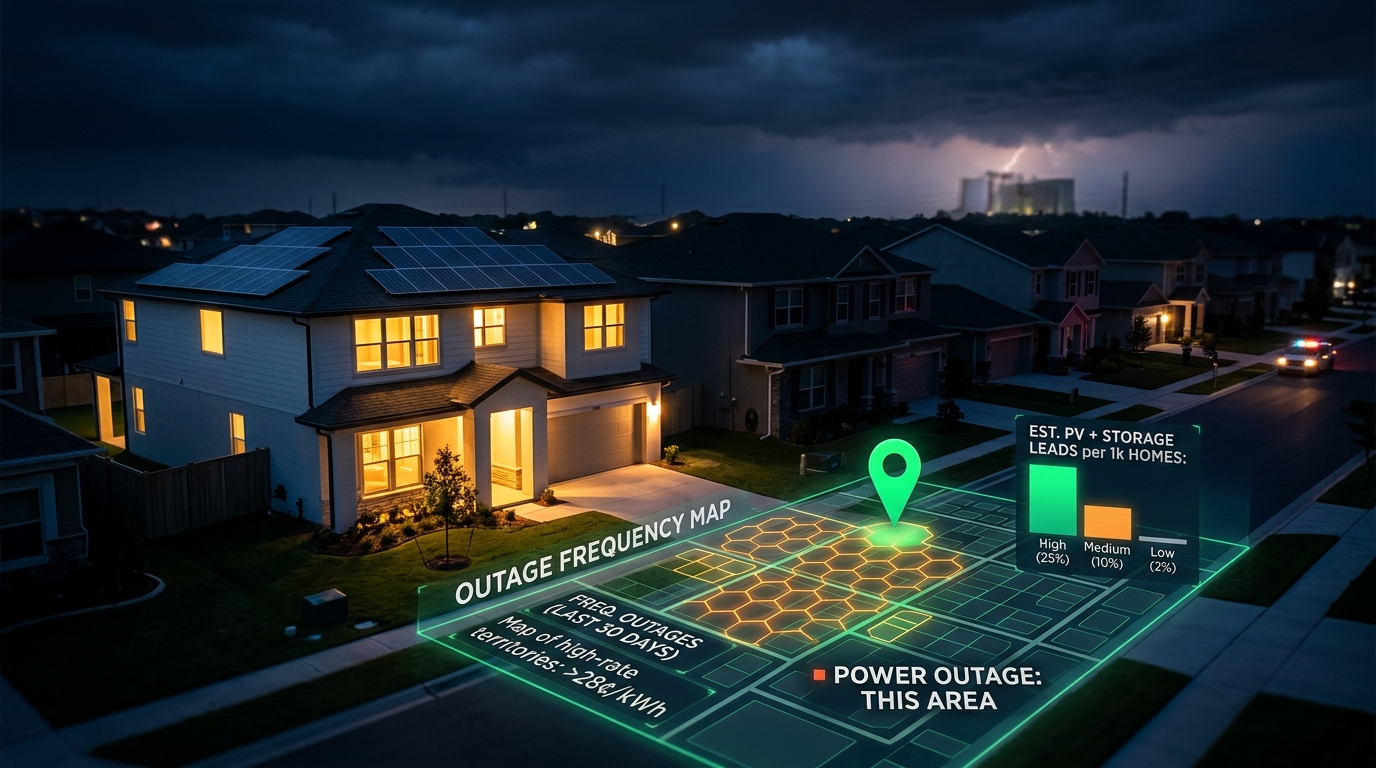
A home that lost power three times this month, in a state where electricity runs 30 cents a kilowatt-hour, is the cleanest battery lead there is. The outages make the backup case and the rate makes the savings case, and the homeowner has already lived both. The only thing missing is a list that names which homes those are, on which streets, before the next outage. That is what outage data gives a home battery or BESS installer: the addresses a utility reported out last week, filtered to the markets where a battery is the right product.
Battery installers tend to inherit the solar playbook, which buys leads or knocks doors picked by rooftop and rate alone. The reliability signal is missing from that picture, and it is the strongest demand trigger a battery has. This is the battery version of how installers turn outage data into leads; the data is the same as the solar and generator versions, sorted for a different door.
What are the best leads for a home battery business?
The best battery leads sit where three signals stack: outages are frequent, they are short, and electricity is expensive. Frequency keeps the reliability problem top of mind, short duration means a battery actually solves it, and a high rate adds daily savings on top of backup so the install pays for itself faster.
A 10-kWh battery covers a typical home for four to six hours. That runtime is the whole story. In a market where outages are frequent but rarely exceed that window, a battery keeps the lights on through almost every event a homeowner will face, which is exactly the pitch. Where outages run eight or twelve hours, the homeowner needs a generator instead, a split we map in generator and battery demand hotspots.
So a battery lead list is not just "homes that lost power." It is homes that lost power in a territory whose outages fit inside a battery's runtime, in a rate environment where the math closes on savings alone.
Which areas have the most demand for home battery storage?
Dense, high-rate states with frequent short outages lead the country for battery demand. Over the last 90 days, the highest outage density by county was:
- Maryland: 2,089 events per county across just 15 counties. Restorations average around five hours and rates sit in the high-20s per kWh.
- New Jersey: 2,055 events per county, every one of its 21 counties active. Short restorations and 27-plus cents per kWh in counties like Atlantic and Cape May make it the textbook battery market.
- Massachusetts: 1,523 events per county. Middlesex and Essex counties each logged outages on most of the last 90 days, with single events hitting 7,000 customers, at fast restoration times that fit a battery's window.
- The New York City boroughs: 44 to 49 cents per kWh, the highest residential rates in the country. Queens alone logged 3,632 events in 90 days and Kings 2,528. Dense, frequent, and expensive: the rate carries the sale even where individual outages are small.
These are different from the generator markets on purpose. The long-restoration states (Nevada, Kansas, Oregon) sell generators; the dense, fast-restoration, high-rate corridor from Maryland up through Massachusetts sells batteries. The state-by-state grid breakdown carries the density and restoration columns to sort any state into one bucket or the other.
Why do frequent short outages signal battery demand?
Frequent short outages are the signal a battery is built for, because they are annoying enough to drive a purchase but short enough that a battery actually fixes them. A homeowner who loses power for two hours every few weeks does not want a generator they have to fuel and maintain. They want the lights to stay on without thinking about it, which is a battery.
The frequency is what creates the lead. A single two-hour outage is forgettable. Three of them in a month is a homeowner googling "home battery backup." In the last 90 days, counties like Middlesex, Massachusetts logged outages on all 90 days at an average of just 73 customers per event, the pattern of constant small interruptions rather than rare big ones. That profile barely registers as a generator market and is prime battery territory.
The rate is what closes it. Above roughly 20 cents per kWh, a battery earns its keep on rate arbitrage and time-of-use shifting even in the months nothing goes dark. New Jersey, Maryland, Massachusetts, and the New York metro all clear that bar with room to spare, so the backup pitch and the savings pitch reinforce each other instead of competing.
How do I work a battery backup lead list?
Lead with the pattern, not the product. The homeowner who lost power three times this month does not want a spec sheet on lithium chemistry; they want someone who noticed the pattern they have been living. "Your street was on the utility's outage report three times in the last month, all of them an hour or two. That is exactly the kind of thing a battery handles without you lifting a finger." That opener is true and it lands.
Three things make a battery list convert at the door:
- Repeat outages, flagged. A street hit once is a maybe; a street hit two or three times is a buyer. Sort the list for the blocks that keep losing power, not just the ones that lost it once.
- Short restorations. Confirm the outages fit a battery's runtime. If a territory's outages routinely run past six hours, it is a generator conversation, and selling a battery there sets up a callback you do not want.
- High electricity rates and owner-occupancy. The savings half of the pitch needs a high rate and a homeowner who keeps the asset. Census and EIA data, joined to the list, filter both before anyone knocks.
A battery installer working this list spends the day in front of homes that already have the reliability problem and the rate to justify solving it.
How are battery leads different from solar and generator leads?
They come from the same outage data, sorted by different columns. Battery installers sort by outage frequency, short restoration, and high rates. Generator dealers sort by long restoration and rural housing, covered in generator leads from outage data. Solar installers sort by rates, rooftop density, and single-family share.
The same county often feeds more than one product. A California county like Contra Costa runs frequent outages at 36 cents per kWh, which is a battery sale in the dense suburban ZIPs, while its exurban ZIPs with longer restorations lean generator. The skill is reading restoration time at the ZIP level and pointing each product at the doors that fit it. The underlying feed never changes; the filter does.
This is the channel GridProfile was built for. Our leads product resolves utility outage reports down to named homes and addresses, flags the streets that keep losing power, and joins the rate and housing data so a battery crew can knock the exact blocks that fit. Or grab a free grid profile of your territory to see the outage frequency and restoration times in your own market first.